

Training Your People is Like Training a Cat
A couple weeks ago, I was having dinner with a couple cousins I hadn’t seen in a while. And the topic turned to… my cats. Specifically, how I had trained my cats to do things most people wouldn’t expect cats to do. Common dog trips like high five, come here, and sit. Leash training. Getting comfortable with other animals and people.
The fact is, I used the same approach I use to training people – I found their incentives, and gave them a motivation to learn.
You see, when most L&D programs fail, it’s not because employees lack interest in growing, but rather that learning is treated as a secondary chore stacked on top of an already full workload. For employees, like a cat that just hears me saying “sit… sit… sit!”, this comes across as a compliance drag, with no clear benefit to them.
Incentives bridge the gap between your or your business’ objectives and an individual’s personal motivation. When properly aligned, they give employees (and cats) explicit permission and motivation to prioritize development.
To transform talent development from a passive expense into a measurable performance multiplier, organizations should build their programs around incentivizing employees.
The Research Behind Incentivized Learning
Psychologist and behavioral economics pioneer Daniel Kahneman found that people learned word pairs quicker when offered (in the experiment, monetary) incentives. Subsequent research confirms that when upskilling carries no tangible or immediately apparent reward, employees make a rational choice: they prioritize the daily tasks that drive their immediate performance reviews and meets deadlines. Building a structured incentive model bridges this gap, aligning your objectives with an individual’s more immediate career goals.
The data behind incentivized development speaks for itself:
Drastic Performance Lift: A major meta-analysis conducted by the Incentive Research Foundation (IRF) revealed that properly designed incentive programs can boost individual workplace performance by up to 44% when sustained over time.
Higher Engagement and Application: According to Harvard Business Review, traditional, isolated training programs rarely alter workplace behavior on their own. In fact, up to 70% of employees skip or tune out standard video training unless learning is experiential, collaborative, and tied directly to visible career pathways. As someone who came up through the L&D field, I can tell you honestly that I experienced this myself as a learner.
Lower Turnover and Higher Margins: Workplace studies by Gallup show that companies offering clear development pathways combined with structured recognition achieve 21% to 51% lower voluntary turnover alongside 23% higher overall profitability.
The 3-Tier Incentive Framework
Now that we have established that plenty of research shows you best develop your people when you clearly align incentives to their learning and development, we should answer, “How do I do that?” And, ideally, “How do I do that on a budget?” You don’t need a complex and expensive incentive structure to make a training program work. But you also need to do a little more than relying on a single reward approach, and take a deep look into what will motivate your workers. Here are a couple ideas to get started:
1. Monetary Incentives (Direct ROI)
One-time micro-bonuses or stipends for earning industry-recognized certifications. Some accounting firms like this one will help cover the cost of certifications.
Salary adjustments for specialized skills, even if those skills are acquired when the individual is already employed. For example, the US military provides a financial bonus to proficient foreign language speakers.
Subsidized tuition or dedicated wellness/development budgets for top learners. Cigna has a well-known program.
2. Professional Incentives (Career Velocity)
Map career progression steps to specific skills and behaviors (competencies), making it easier for employees to see what it is they need to develop. I’ve worked with clients to define career progression more specifically with a deep focus on defining specific competencies and how they differentiate up and down the ladder.
Access to executive mentorship programs and high-visibility stretch projects. Many companies do this through leadership development programs, but there is no need to limit it to just high -potentials.
Guaranteed dedicated "learning hours" carved out of the regular workweek so employees don't have to study on their personal time. Hubspot has been an ardent practitioner of this for years.
3. Social & Cultural Incentives (Recognition)
Public recognition during company all-hands meetings and internal newsletters. Atlassian has this as part of an internal kudos board.
Peer-nominated learning awards and digital credentials shared across company channels. IBM offers digital badges to celebrate learning and growth.
Structure a coaching and mentoring program where you “graduate” to teach and coach others. As I talked about in a previous blog post, this is something the military does well, and has led me to the career I’ve grown.
Best Practices for Rolling Out Learning Incentives
Reward Application, Not Just Completion: Don't incentivize passive video watching. Tie rewards to practical milestones, such as applying a new skill to solve an operational bottleneck or training a peer. When I was training my cats, I’d first provide their favorite treats every time they performed an action. Then, every other time. I continue to reward them, but it’s not just about “completing the action.” Rather, it’s about accomplishing the goal.
Shorten the Feedback Loop: Delayed recognition loses its impact. Acknowledge and reward completed learning milestones as close to real-time as possible. For example, when I was training my cats, I had the treats ready to go. As soon as they performed the desired action, I clicked a button and provided the treats. This signaled that “hey, that thing you just did? That was good!”
Equip Managers to Be Champions: Ensure department leads actively tie training accomplishments to team performance reviews and 1-on-1 career discussions. Or, for a cat, more treats and chin scratches.
When you incentivize continuous learning, you stop asking employees to find time for training—you give them a clear, compelling reason to make development a core priority. The result is a more agile, high-performing team capable of driving real organizational growth. Or, a cat that will back to you when called.
Want to learn more about how you can develop your workforce? Book some time today and let’s talk! I’ll bring the treats.
An example of one of my cats showing off what he has learned. I found that training my cats for both fun things like tricks and important things like wearing their harness, coming back to us when called, not scratching the couch, etc all follow the same principles as training humans. You can also watch this video on Sound Talent’s instagram account.
Annual Planning: Smart Talent Planning for Growing Businesses
It’s annual planning season – business leaders around the world are beginning the long and difficult work of forecasting what they want and expect to achieve in 2027. I’ve been in dozens of these, from initial drafts to rewrites, goal generation (and goal rewrites), and to final publish of our strategic plan.
I’ve also been in the revisions of the plan, often at the end of the year or early Q1, when the chaos that is reality hits home and those pie-in-the-sky hopes encounter hiring delays, budget overruns, and burned-out teams. And, more often, I see smaller businesses stuck because of poor planning around their people operations, which becomes significantly more impactful when you realize that as much as 70% of a small- or medium-sized company’s expenses are tied to their people.
Successful annual planning is more than getting the target numbers right. Successful businesses align headcount pacing with their financial realities, and talent development with their business milestones.
Today, I am going to touch upon some of the more common missteps I’ve seen, highlight the risk and impacts, and suggest steps to better planning.
Headcount Pacing

We’re often really good at planning our goals and milestones for the year. But often, we miss opportunities to ensure we align our talent strategy with our larger goals.
I was working with hiring manager who had a position to fill. Their goal was to have the roll filled and the hired employee to be doing the work within 30 days. They also pushed back on the suggestion of a multi-day onboarding (I’ll dive deeper into this another day), saying “I need them doing the work immediately.”
While this may be a bit of an extreme example, given we are focused on annual planning here, the Ramp-Time Delusion still becomes a factor here. I’ve seen goals of hiring 5 new hires in Q1, and the rest of the planning to assume 100% productivity by Q2. Different scenarios, same problem.
The truth is, you probably want to assume closer to 2-3 months, and maybe as much as 8 months, from job posting to full productivity. Which means, if you are planning in August, and happen to have the funding to post the job in time for October, you should be expecting to have someone in place and fully onboarded and comfortable enough in their job to contribute to your goals by about May. Maybe you get lucky and have someone ready to go in January. But, I would hesitate to build your goals on a foundation of luck.
What I have found is that, more often than not, hiring and onboarding take longer than what was aggressively planned, and delays mount. You can significantly reduce this time by as much as half with a structured onboarding plan, but either way you’ll want to be mindful of this pacing. Otherwise, you might run into a huge issue if you are depending on a round of financing or an a promised product update.
Static Headcount Wishlists
I’ve seen companies fight for headcount, and leaders have to make difficult all-or-nothing decisions based on their financial realities. I once heard “there’s no way we can accomplish what we want with anything less than what I’m asking” in a planning meeting, as a leader was upset at not getting their target headcount approved. Leaders find themselves deciding between two risks: over-hiring, where a potential revenue slump leads to culture-damaging layoffs, or under-hiring, and burning out your teams while seeing, at best, incremental growth.
The danger? In a landmark study of over 3,200 scaling companies, the Startup Genome Report found that 74% of high-growth startups fail due to premature scaling—specifically hiring and expanding team size ahead of actual revenue or product validation. Prematurely scaled teams were found to be 3x larger than necessary for their actual growth stage.
If it works for your organization, consider milestone-gating hiring, where you tie role releases to concrete performance triggers. “Open senior backend engineer hire after reaching $X ARR” or “Add Operational Manager upon shipping Product Y.” Building flexible Tiered headcount models, defining core headcount to maintain and grow the business within reasonable expectations separately from growth conditional headcount that can supercharge your business or save employees’ time.
The End of Year Surprise

Sometimes change happens. Your change management and ability to keep your employees engaged become much easier when you look around corners and assess risk during annual planning.
There we were, 5 calendar days before employee would learn their annual compensation raises, when, out-of-nowhere, the compensation plan changed. Everything we had communicated and had built in anticipation of a normal annual compensation review was now obsolete. In 5 days, we had to learn the new policy, review where there was now misalignment with known policies and trainings, and write the new policy and education. As you can expect, we did not pull off a clean pivot, and the result was angry employees.
Compare that to another instance where we planned a change to running compensation, this time involving a change in the equity vs cash mix, but we had time to run some user testing, get feedback from a small circle of employees and managers, preview changes, and roll out fully reviewed updates with Q&As ahead of the announcement. Now the questions we got were more deep dive in nature, and on the whole most employees were receptive or even excited.
Sometimes surprises happen, we all get that. But some surprises can be somewhat anticipated. Doing a risk analysis and playing out some scenarios ahead of time gets you a head start on doing the work correctly when a sudden surprise hits you late. Research back up the value of early communications of leader and manager decisions drive 70% of the variance in team engagement.
Conclusion
I could run down many more common people operations issues that can be addressed during annual planning, but that’d be closer to a book than a blog post. In summary, when it comes to people operations and talent, a lot of times we plan for the best case scenario, rather than our most likely outcomes. While product roadmaps still sell the vision, the talent strategy executes it. The companies that succeed treat their talent strategy with the same rigorous approach as their core product or service planning.
Are you finding yourself stuck during annual planning and need help defining your people goals? Don’t let rigid planning burn your runway or your people. If you’re building your 2027 strategic plan and want to align your headcount pacing with financial reality, let’s grab a coffee and chat!
Cash vs. Equity: How Giving Employees a Stake Pays Off
This week, entrepreneur Mark Cuban laid out an idea for all employees of a business to receive company equity as part of their compensation. His stated reasoning was that this would be a tool to help tackle rising income inequality.
As someone who works with companies on their equity and pay structures, this caught my eye. In fact, I remember a time when a company I worked for chose to replace equity with cash pay for entry-level warehouse workers. Ironically, the company's stated goal was also to address income inequality.
I won’t use this post to debate Cuban’s specific ideas. Instead, I want to look at how equity works as a pay strategy, why employees care about it, and how a growing business should evaluate it.
What Is Equity Really Worth?
In simple terms, equity represents ownership in a business. On a financial balance sheet, accounting equity is calculated as total assets minus total debts. This is called the "book value."
However, when you give equity to employees, you aren't using book value. You are using the company's Fair Market Value— what the business is actually worth on the market based on its earnings, brand value, and growth potential.
When you give employees equity, you make them partial owners. The logic is based on the following premise: when workers own a stake in the outcome, they are more aligned with the company's long-term success, and therefore become more productive.
How Ownership Helps the Business
Giving workers ownership in the company has repeatedly shown to be a net benefit to companies. A study from Rutgers University looked at public companies over a 13-year period and found that companies where employees owned at least 5% of the stock were 24% less likely to go out of business compared to companies without employee ownership.
The study showed that companies’ survival was based less on cash reserves available and more on employment stability and retention(remember retaining a good employee saves between 50% to 200% of annual salary costs for a company). Workers at employee-owned companies were more committed, stayed with the company longer, and worked together better during tough economic times, according to Rutgers.
Understanding the Upside (and the Catch)

An equity strategy as part of your overall compensation plan could be a long-term boon to employees.
Let's look at a simple example to see how equity can build wealth over time.
Imagine two workers at a business that grows 10% each year:
Worker A: Earns a $60,000 cash salary each year (0% equity).
Worker B: Earns $55,000 in cash salary plus a $5,000 equity grant each year.
Assuming 10% annual growth on those equity grants:
Year 1: Worker A earns $60,000. Worker B holds $55,000 in cash + $5,500 in equity value ($60,500 total).
Over 3 Years: Worker A has earned $180,000 in cash. Worker B’s cumulative salary and grown equity equal $183,205.
Of course, equity carries risk. If the business loses 10% of its value each year, Worker B would end up with $177,195 over three years.
The Catch for Small Businesses: In a publicly traded company, Worker B can sell their stock anytime. But in a private small business, equity is usually illiquid, meaning employees cannot turn their equity into cash whenever they want. They usually must wait for a major milestone, such as the sale of the company, an IPO, an exit, or a formal company buyback plan.
Why Employees Value Equity
Even with the wait, workers place high value on equity compensation. A 2025 study by Charles Schwab showed just how important stock ownership is to everyday employees:
76% of stock plan participants say equity compensation is very important to them.
Nearly half (47%) consider equity a "must-have" benefit when choosing a new job.
72% say equity pay makes them feel confident they will reach their long-term retirement goals.
Choosing the Right Equity Strategy
Equity looks different depending on the size and structure of your business:
Large/Public Corporations: Typically use Stock Options or Restricted Stock Units (RSUs). Stock options give employees the right to buy shares in the future at today’s set market price. If the company grows, the worker profit on the difference.
Small Businesses and LLCs: Can offer real equity like Profits Interests (which give workers a share of future growth). Or, they can use synthetic equity like Phantom Stock or Unit Appreciation Rights, which, simply put, pays out cash bonuses based on company growth without giving away actual voting ownership.
Is Equity Right for Every Employee?
While I do agree that equity builds long-term wealth, business owners must consider their target employees’ immediate needs. An entry-level employee with student debt or a worker in a minimum-wage position may prefer immediate cash pay over equity that might take years to pay off—the classic "a bird in the hand is worth two in the bush" mentality. Their needs may outweigh the perceived benefits, and now you struggle retaining, or even hiring, workers.
That said, growing and bootstrapped businesses should seriously evaluate equity as part of their compensation strategy. It allows you to attract top-tier talent, boost retention, and align incentives without overcommitting your short-term cash flow.
If you are a growing business considering an equity strategy for your team and would like to chat, let’s set up a call today!
The Hidden ROI of Operational Transparency: Aligning Culture and Data
Recently, I had a great conversation with a Lee Berry of Emerald Solutions that inspired some thought in me.
Emerald Solutions provides sustainability technology to businesses, using the business’s own data to provide insights into the measure of their impact on the environment, with a goal of making sustainability achievable for every company.
As we were talking about the environmental reports he provides to his clients, I caught a quick comment about how many times, he finds that the people who most value this report are the employees. So, naturally, it got me thinking – why is that?
As we continued exploring this space, I learned that in many cases, employees see this report as a signal to the company’s values – not just a statement on a website, but an actionable and tangible output showing they mean what they say. And it got me thinking about how companies can attract and retain employees by performing business actions that are both necessary, but also reflect their organizational values.
Do employees value company values?

More employees, particularly younger employees, are placing more emphasis on a company’s values as a factor on whether they work for them, and how long they stay.
Studies suggest that many employees, especially younger employees that form the most rapid-growing labor force today, prefer a workplace where they feel their values align. In fact, according to Deloitte’s 2026 Gen Z and Millennial Survey, not only do at least 96% of Gen Z or Millennial employees (remember, anyone under the age of 42-45 belongs to one of these generations) say a sense of purpose is important, but about 40% have rejected potential employees based on their personal ethics.
This is reflected in the conversation I had, as I saw evidence of employees voluntarily reading the produced reports, and even sharing that they appreciated being able to see those insights. In an ideal scenario, the employees would be able to then take steps to improve their work in order to drive better results.
In many ways, it’s similar to a stock award-based compensation plan or an employee Stock Ownership Plan (ESOP).
The strategy behind equity is simple: give employees a tangible stake in the outcome, and they will drive better business results. The same logic applies here. When a trucking company, for example, shows its employees a carbon footprint report, those employees can actively explore better routes or supply chain changes to reduce emissions—which inherently saves gas and cuts costs for the business. But an even stronger result is the increased retention rates a company can see from this report, even when this was not the original intention.
What could be driving this?
Our world, and our organizations, are so interconnected nowadays that it makes sense something like an environmental impact report could have a downstream impact on retention.
Lee and Emerald Solutions noticed this trend from a specific product. But the underlying cause here appears to be a combination of corporate transparency and an alignment with employee concerns. What intrigued me here was that this wasn’t even Lee’s intention with the report – he wanted to provide a service to his customers that could provide useful information that can help leaders make decisions on how to run their operations, and a byproduct was increased employee engagement and retention.
What other examples do you have of an everyday business action that unexpectedly boosted employee morale or aligned with your values?
How I got into talent development
I walked into the command tent, and checked in with the analysts for the evening update. I asked for a debrief on what we now knew about the opposition forces based on reports on our various teams spread out for miles around us. After getting that update, I then asked how they got their conclusions. What tools did they use? What gaps still existed? How reliable was the information? How did they know? And finally, how would they present this to the force commander who needed the best intel possible before approving a critical mission. I listened as the chief analyst walked me through, piece by piece, of their findings, and expertly answered all my questions and challenges.
In this instance, I was not the head of a special force unit, or a high ranking officer. In fact, part of my role was as the “head” of the opposition forces the intelligence analysts and their unit’s teams were facing. More important to where I am now – I was also the battalion training chief. And this moment was a key experience that led me into the world of talent development.
From Command Tents to Boardrooms
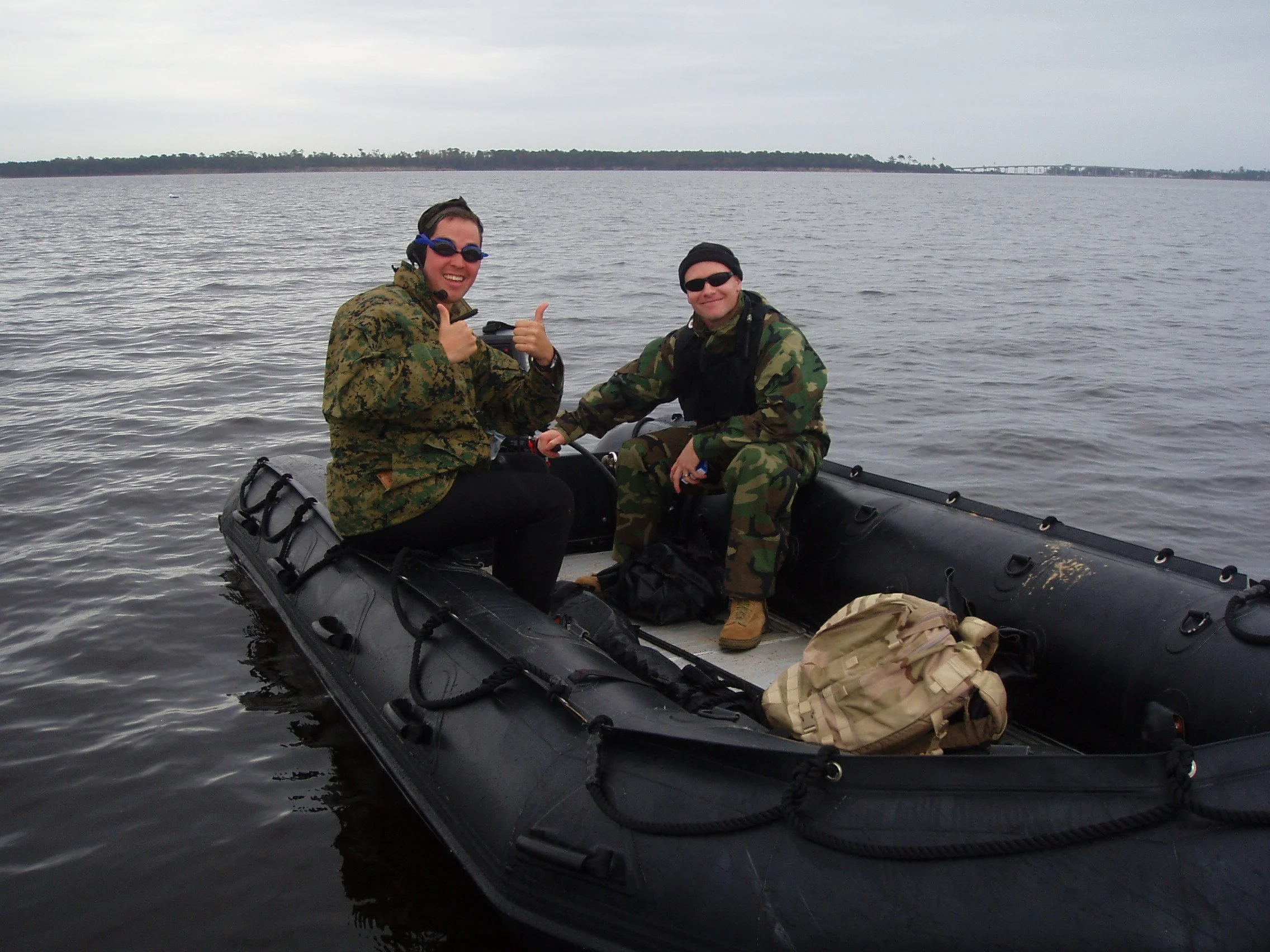
As an Instructor of Water Survival, one of my roles included supporting open water training exercises (and even being ready to serve as a rescue swimmer).
This moment I’m reflecting on, specifically, was the final exercise of a 6-month ramp up for a unit getting ready to deploy. So, for me, the inspiring part was that that same chief analyst had, 6 months prior, been completely unfamiliar with the job skills, the tools, and what he needed to do to be successful. And it wasn’t just him. Most in the 25 person unit – including its officers – had not worked with each other and had not done the specific job requirements in several years, if at all. But through our training program, at the end of the ramp up, and just a few short weeks before their deployment, they were a well-oiled team, operating at a high level, and delivering the results needed to make the whole organization succeed.
I loved this job. In my final year in the Marine Corps (and, for another year several years earlier at a different unit), my primary job role was developing others – new Marines, team leaders, and whole teams. In fact, this was one thing I truly appreciated about the military - subject matter experts are expected to train and develop younger servicepeople. As I myself learned how to develop training programs, design organizational development plans, and coach leaders, I saw how others would grow into highly-capable Marines and teams, and seeing this happen filled me with joy, pride, and a sense of accomplishment.
Several years later, I met with a career coach as I was, at this point, a civilian trying to figure out my next career steps. My coach suggested that, thanks to my background in training, to look into HR, and, more specifically, talent management and development. Admittedly, my initial reaction was “you mean the policy police?” Luckily, I heeded his recommendation, and found a field I became passionate about. I used my experience to become a technical trainer for a top academic institution, and was on may way.
Mission: Growing Talent
Since then, I’ve had the opportunity to learn new tools, experiment with different platforms and approaches, and get involved in projects encompassing the entire employee lifecycle and experience – from drafting a workforce strategy and writing job descriptions to helping create succession plans and develop executive leaders. Throughout these experiences, I’ve been able to harken back to what brought me into the field in the first place - the fulfillment from seeing others succeed. Working backwards from individual and group success has become my primary approach to work, whether working for a company or for a client.
Now, nearly 20 years after the moment I recounted earlier, I get to do the same thing for businesses and their leaders looking to develop their teams to support growth. And I get to experience the same fulfillment as I see people and teams grow not just their capabilities, but their potential, as well. The mission is different. So are the people. The methods are, surprisingly, closer than many may initially think, though in the time since I’ve left the military a lot more research around workforce development has come out. In any case, the sense of pride and fulfillment I experience in helping clients achieve their goals is still there.
Do you have questions about how you can help your people grow? Let’s set up some time to discuss.
Developing Remote Workers - Can You Do It?
Last week, news outlets shared the results from the Federal Reserve Bank of New York placing a large share of the blame for new graduate unemployment on remote work, rather than the commonly-perceived culprit that is AI.
Today, I’m going to discuss less whether or not remote work or AI is the bigger culprit (hint: I do think the interpretation of the data is leading to some inaccurate assumptions), but rather, to look at what are some common pitfalls in coaching, managing, and developing your people - regardless of their career stage - and how you can implement better practices if remote work is a reality for your business.
What is missing
The study compares unemployment rates for young graduates in “remoteable” jobs (such as software engineers), and “non-remoteable” jobs (such as nurses). Because post-pandemic unemployment rates have returned to baseline for non-remoteable jobs but stayed elevated for remoteable jobs, the study is concluding that as much as 64% of the increased unemployment rate for new graduates can be attributed to remote jobs. However, a few things that weren’t touched upon include workforce behaviors during the Great Resignation period, how those that did land jobs during this time progressed during their career, workers that chose to not change jobs or take a promotion in order to stay remote, and how much of this data is due more to company reluctance than actual employee performance.
What is different when developing remote workers?
The study did point out some examples where companies are either not adjusting, or choosing to deprioritize, their development of remote junior employees. For example, the study notes that remote junior employees receive roughly 20% less feedback than their in-person peers. Why does this happen? While some may place the blame on the location of an employee, it could be a symptom of passive management. In a traditional office, mentorship happens by accident (hallway chats, leaning over a desk), as well as in planned structured meetings. However, in a remote setting, mentorship must happen more intentionally. If feedback is dropping, it means we haven’t built intentional, structured digital check-ins. Most current managers built their entire careers in physical offices. They learned how to coach, read body language, and onboard talent purely in person. When the world shifted, many leaders simply tried to copy-paste their old management playbook onto Slack and Zoom and expected the same results. The friction we are seeing isn't because virtual training or coaching is impossible, but rather because so many managers haven’t learned how to manage virtually.
What can I do to help my young remote employees succeed?
Luckily, today’s recent graduates are true digital natives. They spent years navigating remote learning, collaborating across digital time zones, and building projects entirely online during their university years. They are deeply capable of learning and absorbing culture digitally. So, we know the graduates aren’t the bottlenecks.
To help your younger workers succeed, set up more intentionality, which means embracing asynchronous tooling, improving documentation and information organization, and encouraging manager engagement.
Some examples worth exploring include:
Digital shadowing - whereas in an office environment people often invite junior colleagues to sit in on meetings or trainings, doing the same with a virtual employee can help provide them with the exposure to higher-level discussions they need. Include a dial-in number or virtual link, have the employee listen in, and, most importantly, follow up the same day and check in with the employee. Let them ask questions and ask them what they’ve learned or are still unsure about.
Strengthen your documentation approaches - a lot of companies, especially smaller ones, lean on subject matter experts (SMEs) for historical knowledge and for coaching new employees. Creating a robust documentation approach takes a lot of upfront work, but doesn’t take away from the value of those SMEs. What it does is help all employees - new and tenured, to easily access the documentation and information when they need it, without having to find the expert each time.
Peer buddy system - especially true during an employee’s onboarding, pairing a young employee with a peer - not their manager, and ideally not necessarily on their team, to provides new hires a space for questions that they may feel are “silly” or aren’t comfortable bringing up in their 1-on-1 conversations with managers. Provide a stipend for coffee to reward the peer and encourage the meetups.
Train managers to conduct mini coaching sessions - rather than wait for 1-on-1s, encourage managers to provide virtual mini coaching sessions. When in an office setting, these come more naturally as you walk back to your desk from a meeting, or stop by for a “quick chat”. Virtually, this would require more intentionality. and some habit-forming, but something as simple as a Slack message, or building in 5-minute syncs after a presentation or a call to go over questions and feedback.
Focus on the output - Clear onboarding plans that articulate “by the end of Day 90, you should be able to do x, y, and z” gives everyone transparent goals to work towards, track, and measure, Continue doing this after your young employee has “onboarded”, and branch out into development goals to help build their career skills.
Shunning Fresh Talent Creates a Dangerous "Talent Cliff"
Finally, I want to provide some caution for any company pausing entry-level hiring because virtual onboarding feels too difficult. First of all, by creating this barrier right off the bat, you are excluding yourself from talent that could drive your business goals, or even become a future leader. You put yourself at risk of hiring from a lower pool quality. Furthermore, it creates a severe talent vacuum that you end up paying for heavily a few years down the line. Instead of avoiding the challenge, forward-thinking organizations should view this as an opportunity to upskill their leadership and set themselves up for the future, perhaps even at a discount. If you invest in teaching your managers how to coach effectively regardless of location, you gain an edge for the best talent pipeline for the future.
Are you looking for ways to attract, develop, and retain your talent for a sustainable and growth-focused future? Work with Sound Talent Strategy to get this work started!
A Bolt of Energy - How I Would Counsel Frustrated Leaders
If you’re in the HR world, you’ve almost certainly heard by now that Ryan Breslow, founder and CEO of fintech startup Bolt, completely eliminated his Human Resources department. The key tagline repeated was that HR was “creating problems that didn’t exist.” Following a magazine interview, Breslow confirmed on LinkedIn that Bolt got rid of its HR team, doubling down by stating traditional HR brings the “wrong energy.” Interestingly, he followed this claim by explaining Bolt now has a People Operations team to support and train employees.
Naturally, many in my network responded with all the ways this move would backfire, and largely, I agree. At the same time, some startup leaders share Breslow's frustrations, and I completely understand why. While it is easy to dismiss Breslow’s move as a reckless stunt, it exposes a deep-seated, systemic friction between traditional HR practices and fast-moving, lean startup cultures. To get ahead of it, as HR leaders who want to help our supported businesses succeed, we need to analyze the real problems and build strategically to support the speed of the business.
What Do We Know?
Breslow’s decision didn't happen in a vacuum. Bolt is operating in a pressure cooker. After founding the company in 2014, he led it to an $11B valuation in just eight years (maybe I should take some tips from him). He stepped down, and by 2024, the valuation plummeted by 97% to $300M. During this time, Bolt experienced multiple layoffs and, according to Breslow, reckless spending. Now, less than two years after returning as CEO, he is overseeing a significantly leaner workforce, estimated at a couple hundred employees. His core argument is that at this smaller scale, a multi-layered HR team is an unnecessary overhead expense that slows down product and engineering.
What Do We Not Know?
Public statements give us the narrative but leave key operational questions unresolved. If I were supporting Bolt during this transition, here is what I would want to know:
What kind of problems were being created? First and foremost, HR looks to mitigate risk. Were the "problems" actually valid risks? Unconfirmed reports indicate sudden pay structure changes and unpaid contractors. Even if this happened just once, HR likely raised the issue as problematic, but perhaps failed to articulate the consequences in a way the founders valued.
What was the root of these risks? Breslow believes problems were created to justify headcount increases. Possibly. I’ve seen HR implement solutions that were frankly much more troublesome than the root issue, inadvertently aggrandizing the problem.
What is the difference between HR and "People Operations"? Breslow is right that a scaled-down company doesn't need a massive HR department. However, managing people operations—like training and development—is a core HR function. By retaining a People Ops team, he acknowledges HR is still vital. I would bet this scaled-down team still handles payroll, benefits administration, equity, compliance, and onboarding, either through full-time employees or fractional consultants.
Where the Bolt CEO is Right
To fix HR in a company similar to Bolt, we have to admit where it often fails startups. We must acknowledge that HR professionals can over-index on risk aversion, creating rigid, corporate policies that feel arresting.
I remember one HR department implementing a new transfer policy to reduce bad hires. The problem? They were trying to improve a metric that was already successful, shifting the bad hire rate from 5% to 4% (I am making the numbers up here - but it was something along those lines). The result was immense frustration from employees who faced new career development hoops, and hiring managers who needed third-party evaluators and expressed frustrations and prolonging an already time-consuming hiring process.
When HR focuses entirely on policing rather than partnering, they become a bottleneck. Creating processes just to justify their existence actively kills the high-autonomy culture startups need to scale. In a large company, this can often be mitigated as the HR department becomes multi-layered and areas of responsibility are clear. But in a start up, these behaviors can become suffocating.
Where the Bolt CEO is Wrong
Getting rid of HR because they are creating problems is like getting rid of your home’s smoke alarms because the ones you have are too sensitive. Sure, you don’t have the noise annoying you anymore, but you’re setting yourself up for a catastrophe.
A better approach is replacing the current system with one aligned to your needs—moving the alarm further away from the stove, replacing the alarms with ones that recognize the difference between burned toast and an unattended pot roast. Restructure the team to be led by a business-centric Chief People Officer, align HR goals with business goals, and challenge the department to propose solutions rather than just raise issues. Work with the HR teams to maximize efficiency, create processes that are low effort for employees to learn and implement, and ensure the team is consistently aligning its work to business strategy. Scorching the entire department signals a lack of leadership nuance and chooses a headline-grabbing stunt over strategic management.
If It Were My Client
I would recommend a frustrated founder build a “business-first” People team.
Tie strategy to outcomes: The HR team should work with operations to build lean, high-trust frameworks matching the company’s current lifecycle.
Develop a feedback loop: Founders must realize that labor laws, equity management, and workplace safety are guardrails keeping them out of court and legal liability. HR leaders must think like founders, present solutions aligned with the vision, and clearly articulate trade-offs so compliance isn't mistaken for "Wrong Energy."
Audit for process bloat: Create a culture where employees can recommend improvements, look for ways to streamline policies, and execute clear communication strategies for change.
In a later blog post, I’ll go into more detail on how I got into Talent Development and Management, but I do remember being in a counseling session in grad school where someone suggested I consider HR as my field, and my immediate response was “you mean the policy police?” It’s clear that Ryan Breslow - and many other business leaders - have this same mindset. I love working with such leaders, and, just as I was introduced to what good HR (or people operations, or talent) looks like, help leaders see where the value lies, and how we can work together to build an HR team that helps drive the business forward.
Are you looking to scale and are unsure how your people operations could help? Set up some time for a free consult!
Stop Managing Tasks, Start Managing Goals: A Tactical Guide
Recently, I’ve noticed many within my network asking about and sharing tips around staying focused in an effort to maximize productivity, and, crucially, to protect their time.
First of all, I love seeing the exchange of ideas around this topic. A lot of leaders are under tight constraints, and, in many cases, I have seen many of these leaders strive to set good examples to their teams on protecting their time to focus on the most important items on their to-do lists. But how do you do that when people depend on you?
This has been a topic I have loved discussing with leaders throughout my career, so much so that I now offer a course on maximizing productivity. But I’m going to share some quick insights with you here, with the hopes of getting you started with some actionable steps to maximizing your productivity, and doing the right things right.
1. Clarify your main goals
Start first with your key goals – the big projects, the important clients, the growth-supporting needs that will define success. Go the extra step and clearly define your role in supporting or achieving these goals. Avoid trying to cram everything into this list – in fact, use this as an opportunity to determine if you are trying to do too much!
As you write out these goals, make sure they truly are your key goals. This is not a list of tasks, but rather the truly progress-impacting goals that are important to you.
2. Recognize your productivity barriers
Productivity barriers are often sneaky – you don’t see them coming, but when you end up stressed out, tired, or unaccomplished, they are easy to identify post-event. Common productivity barriers include firefighting, lack of clarity or information (meaning you either spend time figuring it out or unmotivated to move forward), cherry-picking easy tasks, poor planning, and external distractions. The common theme with these is that not only do they distract you, but that it takes, on average, more than 23 minutes to fully get back into the flow of work after one of these interruptions. And when you do get back, you are 50% more likely to make mistakes on your important work. Write out some common ones you encounter on a consistent basis.
3. Define What’s important – and what needs to be done ASAP.
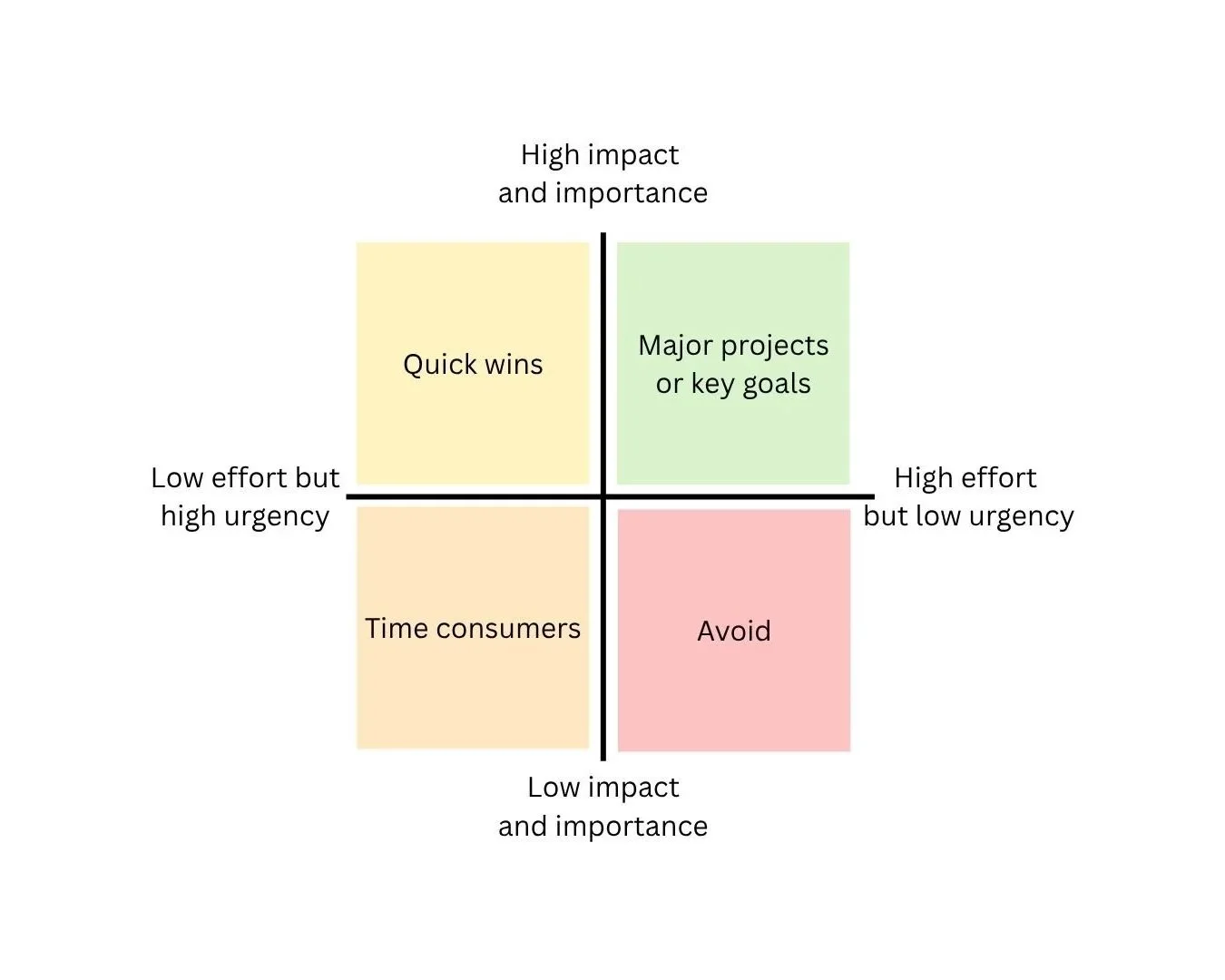
An example of the Eisenhower Matrix. You may see different variations, but main principles are the same.
Think back on your daily work. Sometimes you work on things that appear to be urgent, but they are really an inefficient use of your time and accomplishes very little. Other times you are working on important items, but the deadline, turnaround time, or other constraints makes your work on this inefficient, and you end up not accomplishing as much as you’d like. Still other times, you do have time to do some deep, focused work, and you use that time to truly move a project forward. Think of how you felt after each of these moments, and you’ll notice a pattern. The ability to work on the big impact items with efficiency is a lot more rewarding, and helps your team move forward, than the firefighting or menial work.
Using the goals you wrote, add common work tasks you typically do, then classify them using what is known as The Eisenhower Matrix. Simply: everything you do fits into one of 4 tiers or quadrants: Top Tier is the most important items – major projects, big goals – that you want to make sure you spend time on. Tier 2 are important things that come up and you need to address, often with a deadline, but if you spend too much time on it, you’ll burn out (it’s important we acknowledge these – we can’t always eliminate these items, but we’ll come back to how we manage them). Tier 3 are the items that provide lower value, but you still need to complete… maybe. And finally Tier 4 are things that add no or little value and are inefficient uses of your time. Items directly related to your key goals? Those go into your Top Tier items.
You may see different variations, such as Six Sigma’s Action Priority Matrix, but the main idea remains the same - every task and activity should be able to fit into one of these quadrants or tiers, with items related to the goals you defined above going squarely in the most important tier.
4. Time boxing
Time boxing is a process where you almost literally box out time in your day – but now we are using it for your Tier 1 items. Maybe it’s a client meeting. Perhaps it’s focus time to work on a strategy document. It could be reviewing spreadsheets to identify cost savings opportunity. Whatever it is, if it’s an important item that needs your attention, block it out on your calendar. You can still move it, but the important thing is to protect that time block.
Time blocking by itself helps you overcome most of the productivity barriers from Step 2. Some researches estimate that using timeboxing allows you to do the same amount of impact work of a 60-hour workweek into a 40-hour one. I recommend 30-90 minute blocks of time throughout the day and week.
5. Daily and Weekly Planning
All this work does you no favors if you don’t plan for your week and day. Plan on 30 minutes a week, and 10-15 minutes a day, reviewing your tasks. Did any Tier 2 items come in you need to address, and if yes, what do you need to move to address it? Did a meeting get rescheduled? Do you need to sync with a partner quickly to go over the day’s biggest needs? What are items that you can delegate, or automate, or streamline to reduce the amount of time you have to spend on it? This is your time to answer your key questions and make your calendar work for you and set priorities.
Often the push back on daily and weekly planning is “I don’t have time!”. The fact is, spending a little bit of time up front to plan your day or week increases cognitive flexibility, leads to fewer unfinished tasks, boosts job performance, and supports your well-being. If I told you 10 minutes of planning saves you 2 hours of work later on, I bet you would take that in a heartbeat.
There’s certainly more to discuss, and a lot of this takes practice to make a habit, but these are the key steps to get your started. This is a topic near and dear to me, so much so that I offer workshops to help you maximize productivity in the workplace. We go over these concepts in deeper detail, discuss different approaches, and practice some of the recommendations we discussed above to get you well on a productive – and, importantly, sustainable – path forward.
Set up a free consult with Sound Talent Strategies to learn how you can bring this workshop (or others!) to your team!
Beyond the Bonus: Kickstart Retention on a Shoestring Budget

Looking for ways to compensate and reward your employees but you’re running a tight budget?
I recently read the interview with Kickstarter’s CEO Everette Taylor on the growth he’s helped oversee and the implementation of Kickstarter’s remote work and 4-day workweek culture. It got me thinking about some research I’ve read about the emerging trend of 4-day workweeks, and the fall of remote work’s prevalence in many workplaces.
I know you’re probably thinking “great, another article about remote work or reducing hours.” Well, not exactly.
What catches my eye about success stories like these is leaders looking for ways to support, engage, and reward their employees in ways beyond typical compensation. And, how that translates to employee, and ultimately business, performance.
In Kickstarter’s case (full disclosure, my information is coming only from this article), the drive seemed to come from the fact that, post-pandemic, some of their most valued employees were not living local to their headquarters. Taylor essentially made the decision as a perk to his best employees, and raised the performance bar for the rest of his organization.
When thinking about compensating or rewarding employees, many companies still look at things strictly in a financial sense. The truth is, most employees, once making enough to cover their primary expenses and have a little money left over, find great value in smaller acts of reward and recognition. If you’re on a tight budget, finding creative solutions that employees value can drive retention, and keep your best workers to help drive your growth.
These could be, much like remote work or a 4-day work week, flexibility in time worked. Other benefits to consider would be early exits on Fridays, allowing employees to log off at 2pm as long as weekly goals or deliverables are complete. A variation I’ve seen teams do are Focus Days: one day of the week, say Wednesday, gets blocked out all day so no internal meetings happen, with employees expected to do deep work. Compressed workweeks (40 hours over 4 work days, though I like the 80 hours over 9 work days set up, so every other Friday is off), Mental health days (1-2 days per quarter, separate from sick days), or Volunteer days (a day off to do an act of good for the community), are all examples of flexibility you can provide to your employees as a reward, at no financial cost to your team.
If you’re willing to spend a little bit, but can’t spend it on raises, there are still low-cost options worth considering. Professional development opportunities like a small learning stipend (think a Coursera class or a year of Linkedin Learning instead of a major conference), mentorship circles where individuals connect with senior leaders over coffee (and the company covers the coffee), or subscriptions to apps like Headspace are all in most firms’ budgets, even during tight financial times, and can make a big difference in employee engagement.

Even when on a tight budget, you can find ways to reward and compensate your employees. Doing so can mean the difference between finding replacements and watching your team and company grow.
I’ll probably dive deeper into some examples in a future post, but broadly speaking, these small gestures return far more on your investments. The latest research suggests the average cost of turnover in the US is over $45,000 per employee, after factoring in recruiting, onboarding, training, lost productivity, and management time. Retention initiatives such as mentoring and development support, flexible work, and recognition programs show a 4.2 ROI, and can lift retention by 87%.
Employees who feel seen through recognition, development, and flexibility are 18% more productive. Including wellness initiatives can reduce absenteeism and lead to healthier employees. The improved engagement and increased productivity leads to, according to Gallup, 23% increased profitability.
Not every one of these options is the right fit for your company, and there are many more that might work, based on your company culture, the workplace, and your goals. Are you looking for ways to motivate and retain your employees, but are worried about what this means for your budget? Work with Sound Talent Strategies to discover ways you can better reward strong performance, even on a tight budget. Let’s work together to help your business grow!
Court Success: Why Your Office Needs a March Madness Pool (And How to Run One
It’s that time of year again. The brackets are drawn, the upsets are predicted, and across the country, millions of employees are subtly (and not-so-subtly) checking scores on their phones.
For decades, business leaders have viewed the NCAA Men's Basketball Tournament—affectionately known as March Madness—with dread, calling it a “productivity killer.” But what if this could be a key tool in driving employee morale, engagement, and productivity?
Instead of fighting the tide, forward-thinking organizations are leaning into the tournament. They are recognizing that a structured, voluntary March Madness office pool is a powerful, low-cost tool for driving engagement, morale, and connection.
The Benefits: Fostering Community, Not Cyberloafing
The most significant benefit of a workplace March Madness pool has nothing to do with basketball and everything to do with human connection.
1. Breaking Down Silos and Boosting Camaraderie
In today’s landscape of hybrid and remote work, creating a unified company culture is harder than ever. An office pool provides a neutral ground where a junior analyst can playfully banter with the CEO over their bracket. It gives employees across different departments something in common to talk about other than a spreadsheet. HR Firm Randstad U.S. found that 89% of workers reported that participating in workplace bracket contests “helped build better team camaraderie.” Research cited by Forbes Magazine showed that such healthy competition is a sign of a positive work culture, which can lead to higher quality work. Still more research shows that a March Madness office pool and other low stakes workplace competitions reduce burnout and increase retention.
2. Mental Refreshment and Enhanced Morale
The tournament offers a built-in, mental “micro-break.” Allowing employees a moment to engage in a shared, fun activity can prevent burnout and make the daily grind more palatable. The same Randstad survey noted that 84% of respondents agreed that office pools make their jobs more enjoyable, and 79% said it improved their level of engagement at work. Furthermore, research from TSheets (now QuickBooks Time) revealed that employees who are encouraged by their bosses to watch the games actually watch fewer hours than those whose bosses discourage it.
More and more, HR leaders are using March Madness to increase camaraderie, reduce burnout, and drive collaborative relationships.
Taming the Beast: Tips for Maintaining Productivity
While the benefits are clear, the tournament is designed to be captivating. You cannot simply flip on the TVs and hope for the best. To protect your company's performance, you need a strategy to keep people engaged, but ensure you still meet your key tasks, timelines, and goals.
1. Set the Ground Rules Early
Communicate clearly about the pool's voluntary nature and reiterate your existing Internet and mobile phone policies. The goal is transparency, not surveillance. Make it clear that while "the madness" is welcome, mandatory work deadlines are non-negotiable.
2. Designate "Tournament Zones"
To avoid having streaming games slow down your network or distract focused teams, create designated areas for viewing. A conference room with the games on during lunch hours or a shared digital channel for score updates allows employees to stay connected without hindering their individual tasks.
3. Encourage "Forced Efficiency"
Steve Karau, a management professor at Southern Illinois University Carbondale who studies cyberloafing, argues that these distractions don't have to be entirely negative. The presence of a distraction can sometimes produce a psychological effect known as "forced efficiency." When employees know they want to catch the last ten minutes of a game, they are often more focused on "buckling down" and completing their tasks beforehand.
4. Champion Non-Monetary Prizes
To keep the event professional and avoid legal complications, explicitly ban entry fees or cash prizes. Instead, focus on bragging rights. Offer prizes like:
Lunch with the CEO.
The winner's picture prominently displayed on the internal homepage.
A coveted prime parking spot for a week.
A "late arrival" or "early departure" pass.
If you want to have some sort of monetary prize like a gift card, be sure to work with your HR team to be clear about steps you need to take to ensure you remain compliant.
The Bigger Picture: March Madness as a Low-Cost Employee Benefit
The beauty of a March Madness pool is that it costs the business nothing. It is a pure engagement play that fits perfectly into a holistic low-cost employee benefit strategy.
Businesses often focus on the big-ticket perks: premium health insurance, matching 400(k) contributions, or high salaries. While these are critical for attracting talent, research consistently shows that they are not the only, or even the most effective, levers for retaining talent and driving day-to-day performance.
The March Madness pool belongs to the critical category of culture-based, non-compensation actions.
The Evidence: Why Leader Actions Trumps Cash in Retention
The premise that non-cash actions drive business outcomes isn't a "soft skill" myth; it is backed by hard data.
Employee engagement is a primary indicator of both performance and retention. According to Gallup's comprehensive state of the workplace reports, organizations with a highly engaged workforce see 21% higher profitability and up to 59% lower turnover in high-turnover organizations.
How is that engagement built? It is rarely through salary increases alone. Instead, it is built through leadership actions that foster a sense of belonging, recognition, and psychological safety.
SHRM research shows that 83% of employees who rate their workplace culture as excellent are motivated to produce high-quality work, compared to just 45% of those in poor cultures.
Furthermore, 42% of employees who voluntarily exit organizations say their manager or the organization could have prevented their departure. This preventable attrition is almost always tied to feelings of being undervalued or disconnected from the team.
Conclusion: Embrace the Opportunity
By organizing a voluntary, structured March Madness office pool, you are sending a clear signal as a leader: "We value hard work, but we also value your mental well-being and our community."
You aren't just letting employees "play." You are strategically leveraging a national cultural moment to strengthen the relationships and morale that form the backbone of your business's performance.
So, this March, don't fight the madness. Embrace it. Your employees—and your retention rates—will thank you.
What Winter Olympians Showed About Leading Through Failure
Like many others, I spent a little over two weeks captivated with the Winter Olympics. My favorite sports to watch are biathlon, figure skating, and this year I really got into the halfpipe competitions. But this year, I was struck by something we all saw, and what it means for our own personal leadership principles.
We’ve all seen the footage. A world-class Winter Olympian—a short-track speed skater, a figure skater, a curler – catches an edges, loses their balance, or pushes the rock a little too hard. In a heartbeat, an athlete on top of their game fails in their mission in front of the entire world.

Figure 1. Adeliia Petrosian falls during the free skate competition. Image courtesy of Getty Images
I first noticed it during the figure skating competitions. Ilia Malinin, Amber Glenn, Adam Siao Him Fa, and many other skaters had errors in their competitions. Athletes who were otherwise performing spectacularly would fall, instantly eliminating them (practically) from an Olympic medal. But every single time, the skater gets back up immediately. Why? Because dwelling on the error, regretting the turn, or nursing the immediate pain (however justified) will not help them reach the finish line.
This is an example of leadership. Specifically, what I refer to as “personal leadership”.
In business, we often frame 'resilience' as bouncing back later. True leadership resilience is rapid resetting. When a product launch fails, a critical presentation bombs, or funding falls through, a leader must process the shock instantly, push off the ice, re-engage, and figure out what it takes to accomplish the goal. The timeline for recovery defines the trajectory of the response. A leader’s speed of reset dictates the team’s reset speed.
How do we take that raw, instinctive athlete energy and apply it to a failing corporate project? Because the fact is, in sport, business, and life, we are all going to find a point where we failed. The biggest difference becomes whether or not you fail properly

Figure 2. Ilia Malinin mid-fall. Notice he immediately recognizes the situation, and despite the mistake, he continues to skate.
This is what failing properly looks like in leadership:
Acknowledge the Data, Fast: The leader doesn't hide the failing graph, the red goals, the poor client pitch; she highlights it. “This is what we set out to do, this is what happened, this is why, and this is how we will do better.” A leader’s job isn't to prevent all failures, but to illuminate them quickly so the team can learn. The curler who pushed the rock too hard and lost the end for his team immediately recognizes what went wrong, and acknowledges it.
Neutralize Blame: The focus is not on who fell, but what we do next. The skater doesn't blame the ice; she checks her skates. The leader doesn't blame the team; she identifies the cause, and looks at how to improve.
Redirect the Energy: The adrenaline of the crash is immediately channeled into the pivot. Yuma Kagiyama tripped in his sequence, and still earned the silver. The leader rallies herself and the team to look at what they learned, what to do next, and how best to move forward.
What is the result of failing properly? Learning, growth, and rapid innovation.
Think of properly failing as research and development. You’ve identified the cause, and can now craft a plan to address the cause and lead to success the next time. Because just as surely as there will be another Olympics, there will be a next time for you, as well. You also build psychological safety for your teams, as you signal that growth is welcome, and encouraged.
When an Olympian falls, they do not just get back up. They absorb the moment, process the failure instantly, and redirect that kinetic energy back into the race. They lead by example. This leader is not afraid to catch an edge, attempt a quad lux, or try to knock away a blocker. She is not afraid to see the graph crash, a goal turn red, or a client walk away. She knows that when she pushes off the ice with determination, she is building the foundation for the future breakthrough. And when she pivots, she is showing the team how to do it, and how to innovate, as well.
Fail properly. Learn from it, figure out how you can improve, and continue your forward momentum. Sound Talent Strategies can work with your leaders to develop the skills to quickly analyze and recover from failures and mistakes, leading to better growth in their leadership and in your business.
The Accidental Manager and Team Burnout
It all begins with an idea.
If you feel like your management layer is more of a mushy middle than a powerhouse, you’re not alone. I’ve been seeing it repeatedly over the years, and the data supports it. Recent Gartner research shows a startling disconnect: only 35% of HR leaders are satisfied with their mid-level managers. Even worse? Only 38% of employees actually like their boss, and less than half trust them. The problem isn't necessarily that people are bad at managing—it’s that they don’t actually want the job.
The Rise of the Reluctant Manager
Most of us have seen the typical corporate ladder in some form like this: keep moving up until you hit the manager rungs. Then, you keep going up, but only as a manager, or, you stagnate your career. We take our best individual performers, give them a team, and think “they’re a high performer, so they will do great!”
The result? As many as 82% of managers are “accidental” managers, including 25% of senior leaders, and the impacts are staggering. The Chartered Management Institute found that employees dissatisfied with their managers are not just dissatisfied with their jobs compared to those with effective managers by a 3-to-1 ratio, but are significantly more likely to leave within the year. Moreover, managers themselves can feel less engaged with the work, proving less effective in leading their teams to drive results.
So, how do you stop the reluctant manager problem?
Stop the "Surprise" Promotion
Most management selection is backward-looking. We promote people because they were great at their previous job, not because they’ll be great at the new one.
To prevent reluctant managers from taking the keys, start having the conversation early to demystify the role.
Simulate the Stress: Give candidates a taste of the “manager” stuff—workload prioritization, difficult performance reviews, and budget calibration.
Provide Mentorship: Only 26% of managers get to talk to a peer about the realities of the job before starting. Change that. Pair them with a current manager for some "real talk."
The Safe Off-Ramp: Create a culture where a candidate can say, "Actually, I’ve seen the job and it’s not for me," without it being a career-killer.
Diagnose the Reluctance
If you already have managers who seem checked out, they are not yet a lost cause. Figure out if their reluctance is addressable (they’re just overwhelmed) or entrenched (they fundamentally hate the work). Talk to your leader to see if they are frustrated with some current but temporary challenge, or with a challenge that is inherent to the role. Are some functions dull or perhaps awkward? Or do they make your leader uncomfortable?
Your leaders may need coaching to learn how to apply new skills to their new role. Or perhaps they need help establishing new habits that makes the admin of management quicker and easier.
The Bottom Line
When a manager doesn’t want to be there, everyone knows it. But when a manager is engaged, they are four times more likely to be high contributors, and those efforts cascade to their teams, in turn developing better future leaders. Investing in a selection process that ensures people actually want the job isn't just "nice to have"—it’s a retention strategy.
Facing this problem with your company? Let’s set up some time to discuss how you can help!
The start of a new era
It all begins with an idea.
My dad was an airline pilot, and for a little while – though, truthfully, during my remember-nothing years – he owned his own small cargo airline. From him, I grew up with an interest in airplanes, and at one point imagined what it would be like to start my own airline. I wasn’t so much interested in, say, taking over an established one, or working up the corporate ladder at one of the big ones. I was much more interested in starting one, figuring out how we’d be different and would grow.

As I grew and my interests evolved, I would occasionally entertain the fancy of my own little startup. In high school, I had, what I still maintain was, the original concept for iTunes – though in my mind it was a service that would burn CDs with your selected songs and mail it to you. Still, the common barrier to these ideas centered around this thought – “I don’t actually know how to do this.”
Today, I open the doors for Sound Talent Strategies, which, for me, provides an opportunity to scratch that business-owner itch, without that self-restricting barrier. After decades in the Talent Development and Human Resources fields, I decided to launch Sound Talent Strategies to help our small- and medium-sized businesses, startups, and growing companies set up their talent departments in a way to best support their business and future growth.
I first found my passion for the field when I was serving in the Marine Corps. After a couple deployments, I was put in charge of training our battalion’s pre-deployment teams. I loved seeing teams work together through our training programs, and comparing the teams and individuals at the end of our programs to how they were performing at the start, and sharing those improvements. I learned a lot about human development and how people learn through experiences, and I decided to pursue this field after my military service. Since then, I’ve had the pleasure of working for higher education institutions and the corporate world, during which I’ve had the pleasure to learn more about the human resources field at large.
My goal is to work with clients to develop holistic approaches to developing and growing their talent. For some, that might be a specific leadership development opportunity focusing on specific outcomes. For others, that might be a broader project in a specific area that they need help in. And still, for some, it may be more of a generalist need that can handle the day-to-day during times of transition.
I encourage you to check out the different services Sound Talent Strategies offers, and if you’d like to learn more, let’s chat! I also encourage you to come back for a visit, as I’ll be using this blog to share some thoughts on talent-related issues and questions throughout the year. Thanks for visiting, and I look forward to getting to know you!