

What Winter Olympians Showed About Leading Through Failure
Like many others, I spent a little over two weeks captivated with the Winter Olympics. My favorite sports to watch are biathlon, figure skating, and this year I really got into the halfpipe competitions. But this year, I was struck by something we all saw, and what it means for our own personal leadership principles.
We’ve all seen the footage. A world-class Winter Olympian—a short-track speed skater, a figure skater, a curler – catches an edges, loses their balance, or pushes the rock a little too hard. In a heartbeat, an athlete on top of their game fails in their mission in front of the entire world.

Figure 1. Adeliia Petrosian falls during the free skate competition. Image courtesy of Getty Images
I first noticed it during the figure skating competitions. Ilia Malinin, Amber Glenn, Adam Siao Him Fa, and many other skaters had errors in their competitions. Athletes who were otherwise performing spectacularly would fall, instantly eliminating them (practically) from an Olympic medal. But every single time, the skater gets back up immediately. Why? Because dwelling on the error, regretting the turn, or nursing the immediate pain (however justified) will not help them reach the finish line.
This is an example of leadership. Specifically, what I refer to as “personal leadership”.
In business, we often frame 'resilience' as bouncing back later. True leadership resilience is rapid resetting. When a product launch fails, a critical presentation bombs, or funding falls through, a leader must process the shock instantly, push off the ice, re-engage, and figure out what it takes to accomplish the goal. The timeline for recovery defines the trajectory of the response. A leader’s speed of reset dictates the team’s reset speed.
How do we take that raw, instinctive athlete energy and apply it to a failing corporate project? Because the fact is, in sport, business, and life, we are all going to find a point where we failed. The biggest difference becomes whether or not you fail properly
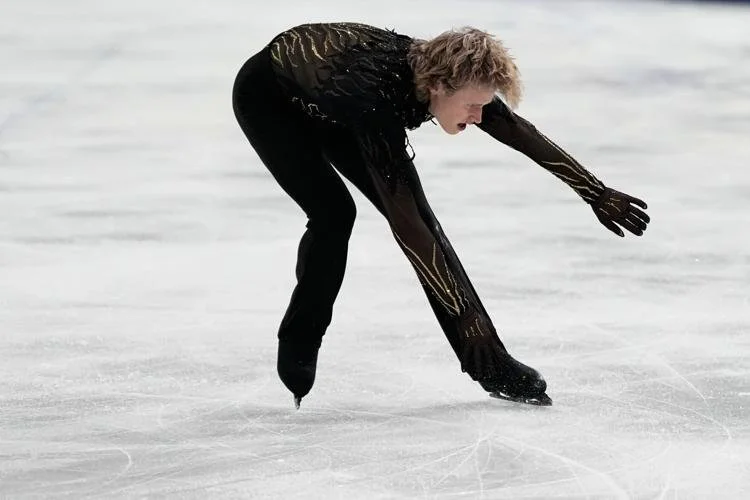
Figure 2. Ilia Malinin mid-fall. Notice he immediately recognizes the situation, and despite the mistake, he continues to skate.
This is what failing properly looks like in leadership:
Acknowledge the Data, Fast: The leader doesn't hide the failing graph, the red goals, the poor client pitch; she highlights it. “This is what we set out to do, this is what happened, this is why, and this is how we will do better.” A leader’s job isn't to prevent all failures, but to illuminate them quickly so the team can learn. The curler who pushed the rock too hard and lost the end for his team immediately recognizes what went wrong, and acknowledges it.
Neutralize Blame: The focus is not on who fell, but what we do next. The skater doesn't blame the ice; she checks her skates. The leader doesn't blame the team; she identifies the cause, and looks at how to improve.
Redirect the Energy: The adrenaline of the crash is immediately channeled into the pivot. Yuma Kagiyama tripped in his sequence, and still earned the silver. The leader rallies herself and the team to look at what they learned, what to do next, and how best to move forward.
What is the result of failing properly? Learning, growth, and rapid innovation.
Think of properly failing as research and development. You’ve identified the cause, and can now craft a plan to address the cause and lead to success the next time. Because just as surely as there will be another Olympics, there will be a next time for you, as well. You also build psychological safety for your teams, as you signal that growth is welcome, and encouraged.
When an Olympian falls, they do not just get back up. They absorb the moment, process the failure instantly, and redirect that kinetic energy back into the race. They lead by example. This leader is not afraid to catch an edge, attempt a quad lux, or try to knock away a blocker. She is not afraid to see the graph crash, a goal turn red, or a client walk away. She knows that when she pushes off the ice with determination, she is building the foundation for the future breakthrough. And when she pivots, she is showing the team how to do it, and how to innovate, as well.
Fail properly. Learn from it, figure out how you can improve, and continue your forward momentum. Sound Talent Strategies can work with your leaders to develop the skills to quickly analyze and recover from failures and mistakes, leading to better growth in their leadership and in your business.
