

Stop Managing Tasks, Start Managing Goals: A Tactical Guide
Recently, I’ve noticed many within my network asking about and sharing tips around staying focused in an effort to maximize productivity, and, crucially, to protect their time.
First of all, I love seeing the exchange of ideas around this topic. A lot of leaders are under tight constraints, and, in many cases, I have seen many of these leaders strive to set good examples to their teams on protecting their time to focus on the most important items on their to-do lists. But how do you do that when people depend on you?
This has been a topic I have loved discussing with leaders throughout my career, so much so that I now offer a course on maximizing productivity. But I’m going to share some quick insights with you here, with the hopes of getting you started with some actionable steps to maximizing your productivity, and doing the right things right.
1. Clarify your main goals
Start first with your key goals – the big projects, the important clients, the growth-supporting needs that will define success. Go the extra step and clearly define your role in supporting or achieving these goals. Avoid trying to cram everything into this list – in fact, use this as an opportunity to determine if you are trying to do too much!
As you write out these goals, make sure they truly are your key goals. This is not a list of tasks, but rather the truly progress-impacting goals that are important to you.
2. Recognize your productivity barriers
Productivity barriers are often sneaky – you don’t see them coming, but when you end up stressed out, tired, or unaccomplished, they are easy to identify post-event. Common productivity barriers include firefighting, lack of clarity or information (meaning you either spend time figuring it out or unmotivated to move forward), cherry-picking easy tasks, poor planning, and external distractions. The common theme with these is that not only do they distract you, but that it takes, on average, more than 23 minutes to fully get back into the flow of work after one of these interruptions. And when you do get back, you are 50% more likely to make mistakes on your important work. Write out some common ones you encounter on a consistent basis.
3. Define What’s important – and what needs to be done ASAP.
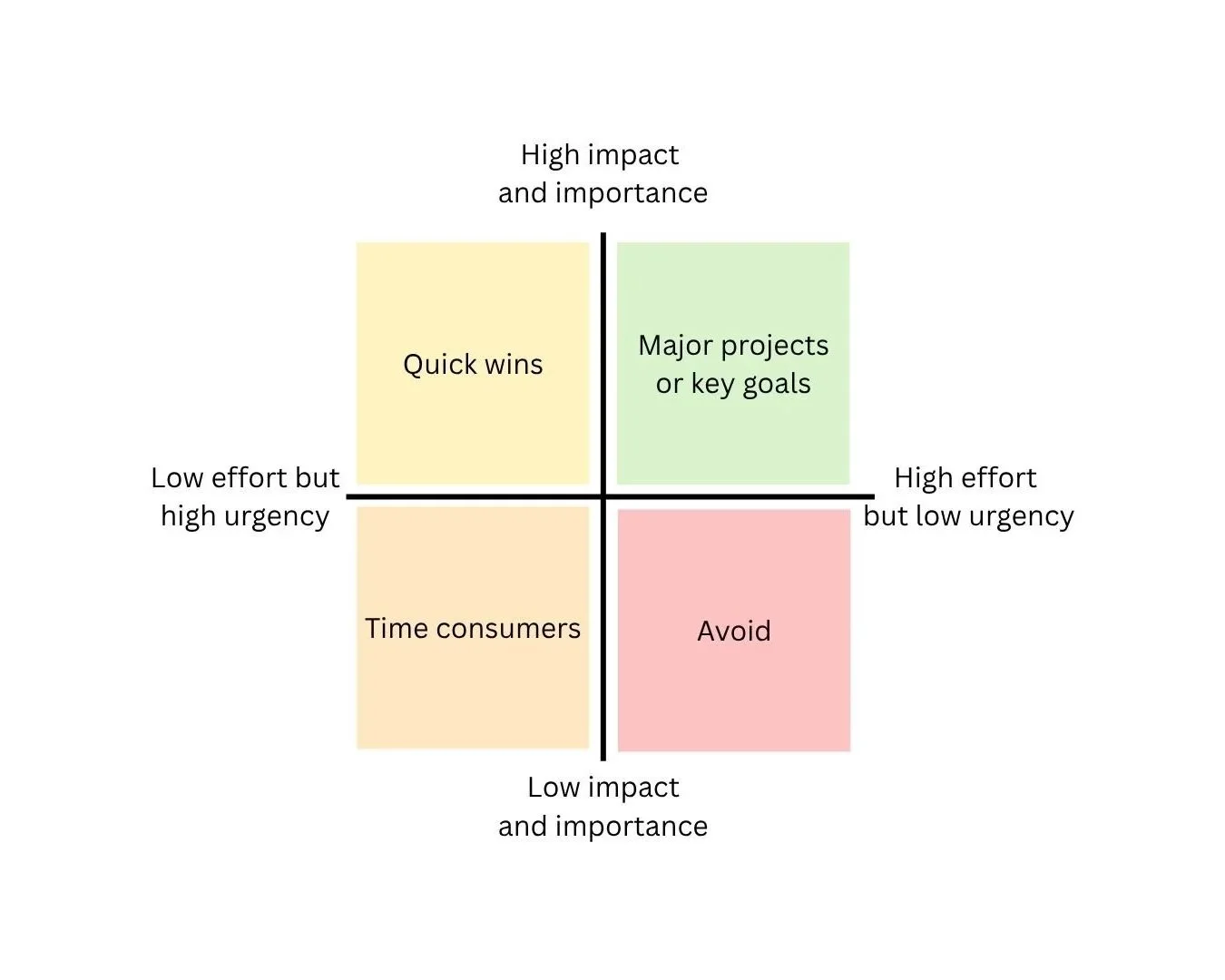
An example of the Eisenhower Matrix. You may see different variations, but main principles are the same.
Think back on your daily work. Sometimes you work on things that appear to be urgent, but they are really an inefficient use of your time and accomplishes very little. Other times you are working on important items, but the deadline, turnaround time, or other constraints makes your work on this inefficient, and you end up not accomplishing as much as you’d like. Still other times, you do have time to do some deep, focused work, and you use that time to truly move a project forward. Think of how you felt after each of these moments, and you’ll notice a pattern. The ability to work on the big impact items with efficiency is a lot more rewarding, and helps your team move forward, than the firefighting or menial work.
Using the goals you wrote, add common work tasks you typically do, then classify them using what is known as The Eisenhower Matrix. Simply: everything you do fits into one of 4 tiers or quadrants: Top Tier is the most important items – major projects, big goals – that you want to make sure you spend time on. Tier 2 are important things that come up and you need to address, often with a deadline, but if you spend too much time on it, you’ll burn out (it’s important we acknowledge these – we can’t always eliminate these items, but we’ll come back to how we manage them). Tier 3 are the items that provide lower value, but you still need to complete… maybe. And finally Tier 4 are things that add no or little value and are inefficient uses of your time. Items directly related to your key goals? Those go into your Top Tier items.
You may see different variations, such as Six Sigma’s Action Priority Matrix, but the main idea remains the same - every task and activity should be able to fit into one of these quadrants or tiers, with items related to the goals you defined above going squarely in the most important tier.
4. Time boxing
Time boxing is a process where you almost literally box out time in your day – but now we are using it for your Tier 1 items. Maybe it’s a client meeting. Perhaps it’s focus time to work on a strategy document. It could be reviewing spreadsheets to identify cost savings opportunity. Whatever it is, if it’s an important item that needs your attention, block it out on your calendar. You can still move it, but the important thing is to protect that time block.
Time blocking by itself helps you overcome most of the productivity barriers from Step 2. Some researches estimate that using timeboxing allows you to do the same amount of impact work of a 60-hour workweek into a 40-hour one. I recommend 30-90 minute blocks of time throughout the day and week.
5. Daily and Weekly Planning
All this work does you no favors if you don’t plan for your week and day. Plan on 30 minutes a week, and 10-15 minutes a day, reviewing your tasks. Did any Tier 2 items come in you need to address, and if yes, what do you need to move to address it? Did a meeting get rescheduled? Do you need to sync with a partner quickly to go over the day’s biggest needs? What are items that you can delegate, or automate, or streamline to reduce the amount of time you have to spend on it? This is your time to answer your key questions and make your calendar work for you and set priorities.
Often the push back on daily and weekly planning is “I don’t have time!”. The fact is, spending a little bit of time up front to plan your day or week increases cognitive flexibility, leads to fewer unfinished tasks, boosts job performance, and supports your well-being. If I told you 10 minutes of planning saves you 2 hours of work later on, I bet you would take that in a heartbeat.
There’s certainly more to discuss, and a lot of this takes practice to make a habit, but these are the key steps to get your started. This is a topic near and dear to me, so much so that I offer workshops to help you maximize productivity in the workplace. We go over these concepts in deeper detail, discuss different approaches, and practice some of the recommendations we discussed above to get you well on a productive – and, importantly, sustainable – path forward.
Set up a free consult with Sound Talent Strategies to learn how you can bring this workshop (or others!) to your team!
